



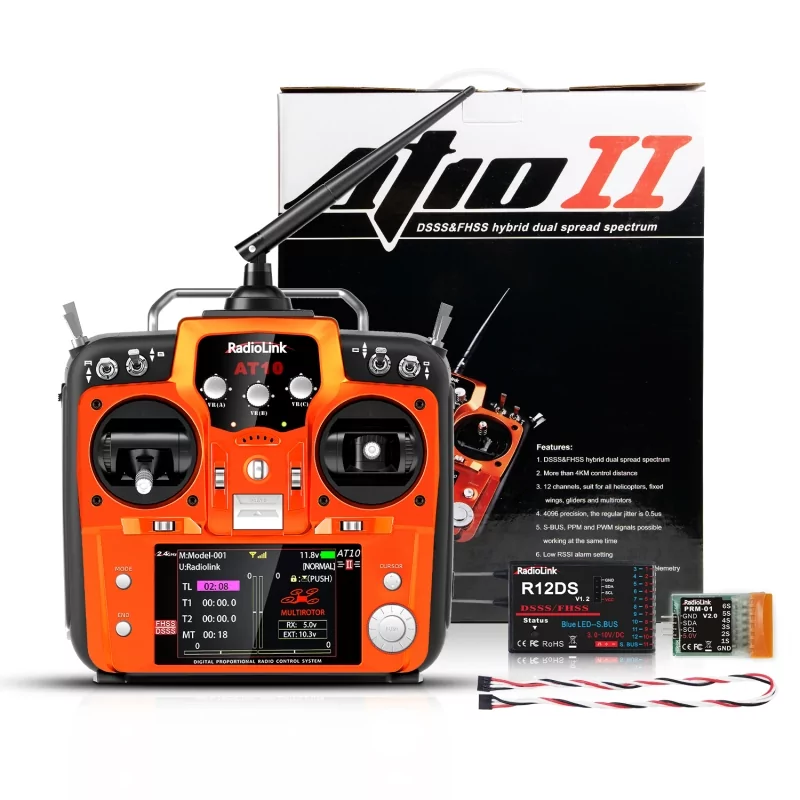
AT10II+R12DS+PRM-01 2.4GHz 12CH Transmitter & Receiver


DSSS* and FHSS* spread spectrum, 16-channel frequency hopping, and QPSK* modulation ensure excellent interference-free performance and a constant, stable transmission signal.
The transmitter antenna’s high gain (7 dBi*) and low signal noise with a 5.0 MHz bandwidth ensure a range of up to 4 km.
The R12DS receiver, with its diversity antenna, handles SBUS and PWM output signals simultaneously. This signal enables reliable reception even at hilly flying sites.
That is why the AT10II transmitter is used for professional drones in agricultural and industrial applications.
The AT10 radio uses new high-speed processors for improved stability and high precision.
All 12 channels respond simultaneously in less than 3 ms.
An easy-to-use radio system for beginners that is sophisticated enough for experts.
This transmitter can be used with different types of models: helicopters, fixed-wing aircraft, gliders, multirotors, cars, boats, and robots.
Several features are available for each type of model. Five model-specific flight programs are available.
The controls are fully customizable (8 switches, 3 knobs, and 2 sliders) and can be assigned to suit your specific needs.
The control layout is automatically adapted to the selected flight mode.
Airplane configurations: delta wing (elevons), conventional wing (1–2 ailerons with 0–2 flaps), V-tail, or conventional tail
Helicopter configurations: H1, H2, H3, H4, HR3, HE3, HN3, and H4X rotor head types
The all-new IC 4096 circuit minimizes unwanted servo micro-oscillations (jitter).
Optimized circuit board design and high-quality potentiometers provide excellent output signal stability. Maximum PWM is 1.84 us, with an average of just 0.5 us, which is essential for highly precise flight.
Model telemetry data is displayed in real time on the AT10II screen.
The large 12.7 x 8.90 cm, 16-color screen is easy to read.
When paired with the PRM-01 telemetry module, the model’s propulsion battery voltage is displayed. When used with the PRM-03 OSD information telemetry module and a flight controller (PIXHAWK, Mini Pix, TURBO PiX, or APM), the model’s voltage, speed, rate of climb, acceleration, GPS position (longitude and latitude), altitude, RSSI, flight mode, and distance are also displayed.
SBUS, PPM, and PWM can operate simultaneously, with seamless operation for the user.
The R12DS receiver included with the receiver works with SBUS and PWM signals.
The AT10II is compatible with RadioLink R6DSM, R6DS, R9DS, and R12DSM receivers.
These compatible receivers cover a wide range of models and applications.
Easy-to-understand graphical display for adjusting settings.
Channels 5–12 can be freely programmed*
An airbrake function is preprogrammed, along with many other mixes, such as aileron/elevator and flap/aileron.
*The number of channels may vary depending on the model type
The AT10II includes an interface compatible with most airplane simulators*.
In simulator mode, the transmitter module can be switched off to save battery power.
The simulator port (located on the back of the AT10II) can also be used for wireless trainer mode.
*Simulation software sold separately. Refer to the software specifications to verify compatibility with the RadioLink AT10II transmitter.
Updating the AT10II with new firmware is easy. Simply connect the transmitter to a computer using a USB cable.
The AT10II radio system is designed for both experts and beginners.
Switches of different lengths are easy to identify and use.
Long control sticks improve movement precision.
You can switch from Mode 2 to Mode 1 with a simple setting on the radio (see the user manual for details).
A throttle stick spring is included for drone users. It allows the throttle control to return to neutral.
Intuitive design and a comfortable feel make the AT10II an excellent transmitter for recreational, sport, competitive, or 3D flying.
The switch-mode power supply (SMPS) uses 50% less energy than similar products. The AT10II draws only 105 mA maximum.
The transmitter can operate for 12 hours with an 1800 mAh LiPo battery.
The universal JST connector allows the AT10II to work with different battery configurations: 8 AA batteries, a LiPo battery (2S–4S), 18650 lithium batteries, Li-ion, NiMH, or NiCad.
If you want to power the AT10II with a lithium battery, make sure the battery has a JST connector and measures 115 x 32 x 30.5 mm. The operating voltage range is 7.4 to 15.0 V.
RadioLink’s voltage protection technology protects the transmitter and receiver from reverse polarity when connecting the power supply.
Configurable audible alarms and messages indicate potential problems, such as low RSSI or low model, receiver, or transmitter voltage.
Radio Radiolink 12 voies AT10II +R12DS+PRM-01